In this article 12 sections
- How to Set Realistic Goals and Track Progress
- Step 1: Start with Why
- Step 2: Make It Specific
- Step 3: Check That It’s Realistic
- Step 4: Break It into Small Steps
- Step 5: Choose a Way to Track Progress
- Step 6: Review Weekly, Adjust Monthly
- Step 7: Celebrate Small Wins
- What to Do When You Fall Behind
- Common Goal-Setting Mistakes
- Frequently Asked Questions
- The Bottom Line
How to Set Realistic Goals and Track Progress
Every January, millions of people write big goals on a fresh page. By February, most of those pages are forgotten.
That doesn’t mean you lack willpower. More often, the goal was too vague, too big, or never tracked in the first place. The good news is that setting goals you can actually reach is a skill, and a simple one. This guide shows you how to set realistic goals and track progress in a way that keeps you moving without wearing you out.
Why Most Goals Fail
Before fixing the problem, it helps to see it. Goals usually fall apart for a few common reasons:
- They’re vague. “Get fit” or “be more productive” gives you nothing to act on.
- They’re too big. A huge goal with no small steps feels overwhelming, so you put it off.
- There’s no plan. Wanting something isn’t the same as knowing what to do on Tuesday.
- Nobody’s checking. Without tracking, it’s easy to drift and not notice.
- Life gets in the way. And the plan has no room for that.
A realistic goal deal with each of these.
What Makes a Goal Realistic?
A realistic goal stretches you a little, but it fits your actual life. It considers your time, energy, money, and current skill level. Research on goal setting, including the well-known work of psychologists Edwin Locke and Gary Latham, suggests that specific, challenging goals tend to lead to better performance than vague ones like “do your best.” The key word is challenging, not impossible. If a goal is so hard that you quit, it’s not helping you.
A good test: if you can’t picture where it fits into your normal week, it’s probably not realistic yet.
Step 1: Start with Why
Ask yourself why this goal matters to you. Not what sounds impressive, but what you truly want. A goal you care about survives bad weeks. A goal you set because you think you should usually do.
Write one or two sentences about your reason. You’ll come back to them when motivation dips, and it will dip.
Step 2: Make It Specific
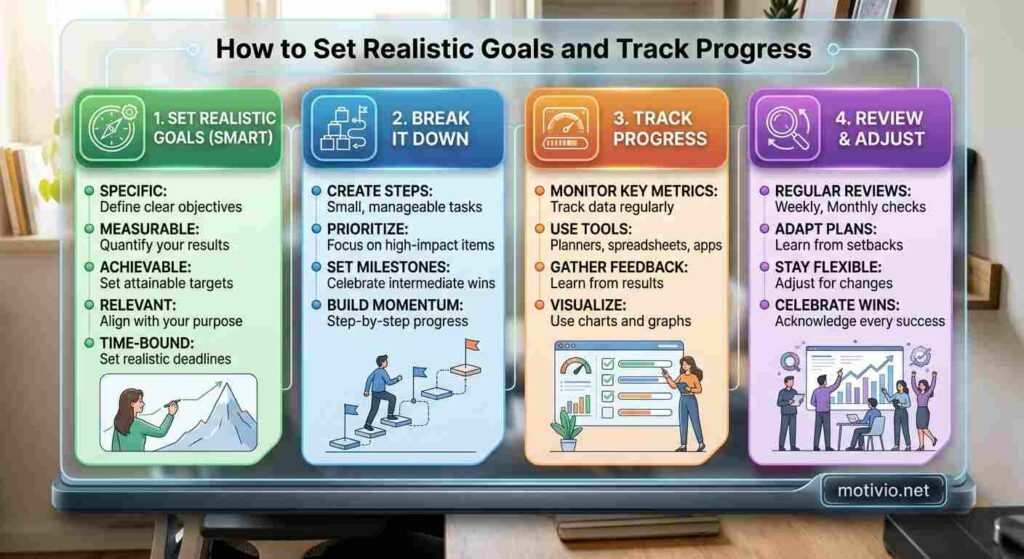
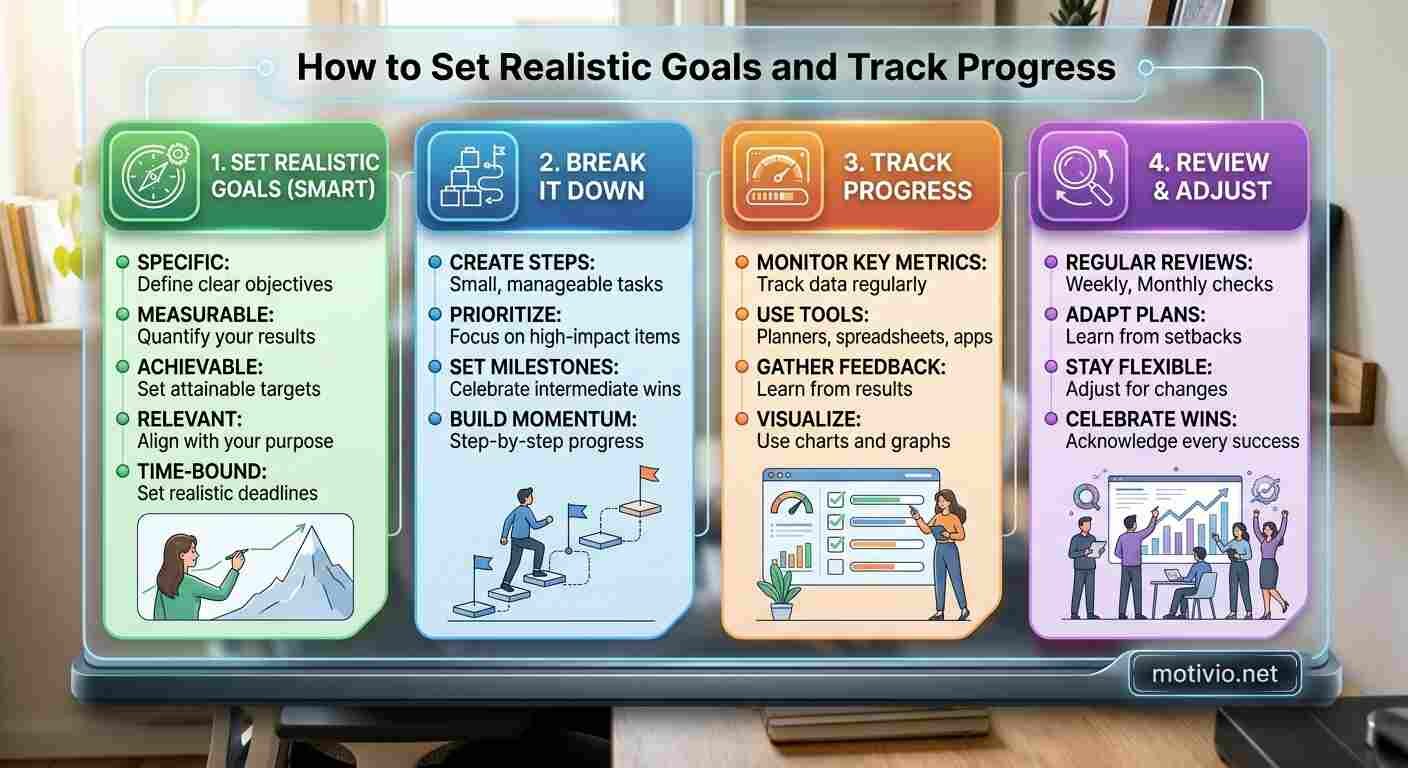
Turn the fuzzy idea into something clear. The SMART goals framework is a popular way to do this:
- Specific: What exactly do you want?
- Measurable: How will you know you’ve achieved it?
- Achievable: Is it possible given your situation?
- Relevant: Does it matter to your bigger picture?
- Time-bound: When will you reach it?
Here’s a quick example.
- Vague: “I want to get healthier.”
- SMART: “I’ll walk for 30 minutes, four days a week, for the next three months.”
The second version tells you exactly what to do and when you’ve done it.
Step 3: Check That It’s Realistic
Be honest about your starting point. Ask yourself:
- How much time can I truly spare each week?
- What else is on my plate right now?
- Have I done something like this before? What happened?
- What’s the smallest version of this goal I’d still be proud of?
If you work full time and have young kids, a goal of writing for two hours every morning is probably not realistic. Twenty minutes, four times a week, probably is. Starting smaller isn’t giving up. It’s setting yourself up to win.
Step 4: Break It into Small Steps
Big goals become manageable when you cut them into pieces. Work backward from the finish line.
Say you want to save a certain amount in a year. Divide it by twelve and you get a monthly target. Divide that by four and you get a weekly one. Suddenly it’s a number you can handle.
For each goal, pick:
- A yearly or quarterly target (the big picture)
- A monthly milestone (a checkpoint)
- A weekly action (what you’ll actually do)
It also helps to make “if-then” plans, such as “If it’s 7 a.m. on a weekday, then I’ll go for my walk.” Studies on implementation intentions by psychologist Peter Gollwitzer suggest that linking an action to a specific time or cue can make follow-through more likely.
Step 5: Choose a Way to Track Progress
Tracking turns a goal from a wish into something you can see. The best method is the one you’ll actually use. Here are a few popular options.
- A simple notebook or planner. Cross off each day you do the thing. It’s old-school, but it works.
- A habit tracker. A grid or app where you marks each day. Seeing a streak builds momentum.
- A spreadsheet. Good for goals with numbers, like savings, weight, or words written.
- A progress journal. A few lines each week about what went well and what didn’t.
- A visual chart. A thermometer or progress bar on your wall can be surprisingly motivating.
Track both actions (what you did) and results (what changed). Actions are in your control. Results take time. If you only watch results, you can get discouraged before they show up.
Step 6: Review Weekly, Adjust Monthly
Set aside ten minutes once a week. Look at your tracker and ask:
- What went well this week?
- What got in the way?
- What’s one thing I’ll do differently next week?
Once a month, zoom out. Are you on track? Does the goal still matter to you? If it’s too easy, raise it. If it’s too hard, scale it back. Adjusting isn’t failing. Its how good plans stay useful.
Step 7: Celebrate Small Wins
Waiting until the finish line to feel good is a recipe for burning out. Notice your progress along the way. Finished your first week? That counts. Hit a monthly milestone? Do something nice for yourself.
Celebrating doesn’t need to be big. A good meal, a day off, or simply telling a friend can keep your motivation going.
What to Do When You Fall Behind
You will miss days. Everyone does. What matters is what you do next.
- Don’t wait for Monday. Restart at the next opportunity, even if it’s tonight.
- Follow the two-day rule. Try not to skip twice in a row.
- Shrink the goal for a bit. Do a smaller version until your rhythm returns.
- Look for the pattern. If you keep missing the same day, change the plan, not just your effort.
Common Goal-Setting Mistakes
- Setting too many goals at once. Two or three focused goals beat ten scattered ones.
- Comparing yourself with others. Their pace tells you nothing about yours.
- Ignoring rest. Recovery is part of making progress.
- Never reviewing. A goal you don’t revisit tends to fade away.
Frequently Asked Questions
How do I know if my goal is realistic?
If you can fit it into your normal week, and you’ve got the time, skills, and resources to begin, it’s probably realistic. If you’re not sure, shrink it and see how it goes.
How many goals should I work on at once?
For most people, one to three. More than that tends to spread your attention too thin.
What’s the best way to track goals?
The one you’ll stick with. A paper planner, a habit app, or a spreadsheet can all work.
How often should I review my goals?
A quick weekly check-in and a deeper monthly review work well for most people.
What if I lose motivation?
Go back to your “why,” make the next step smaller, and focus on showing up instead of being perfect. Motivation often follows action, not the other way around.
The Bottom Line
Learning how to set realistic goals and track progress isn’t about being more disciplined. It’s about being clearer, starting smaller, and paying attention to how it’s going. Choose one goal today, make it specific, break it into weekly steps, and pick a simple way to track it.
Check in with yourself next week. That small habit is where real progress begins.