In this article 13 sections
- How to Build a Weekly Planning Habit for better Productivity
- 1. Choose a Regular Day and Time for Planning
- 2. Look Back at the Previous Week
- 3. Determine Your Key Weekly Focus Points
- 4. Break Big Goals Into Smaller Steps
- 5. Use a Planner to Set Aside Time
- 6. Be Careful with Time Blocking
- 7. Think About Your Energy, Not Just Your Time
- 8. Get Ready for Interruptions and Unforeseen Tasks
- 9. Develop a Daily Review Routine
- 10. Keep Your Planning Method Simple
- Frequently Asked Questions
- Conclusion
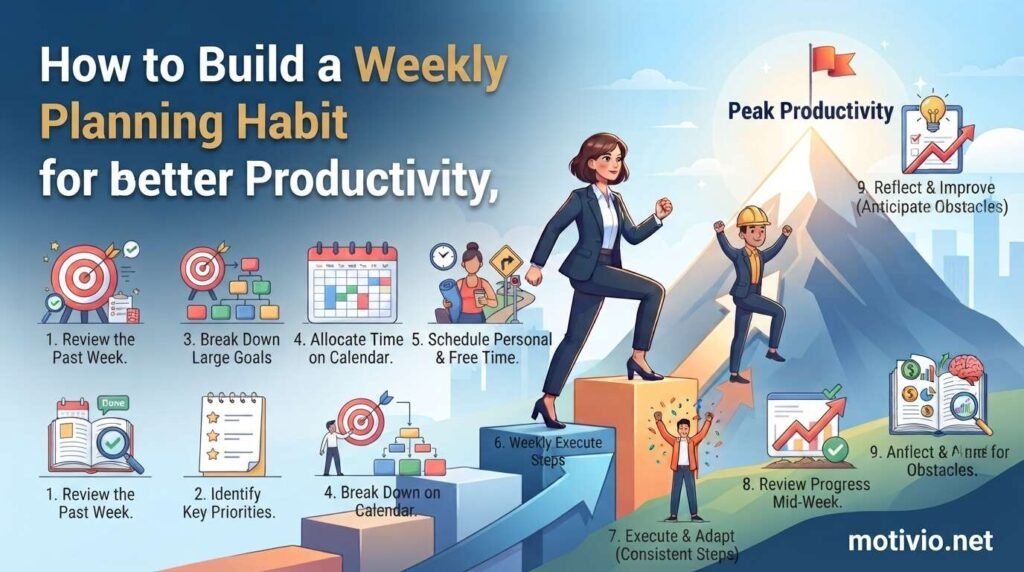
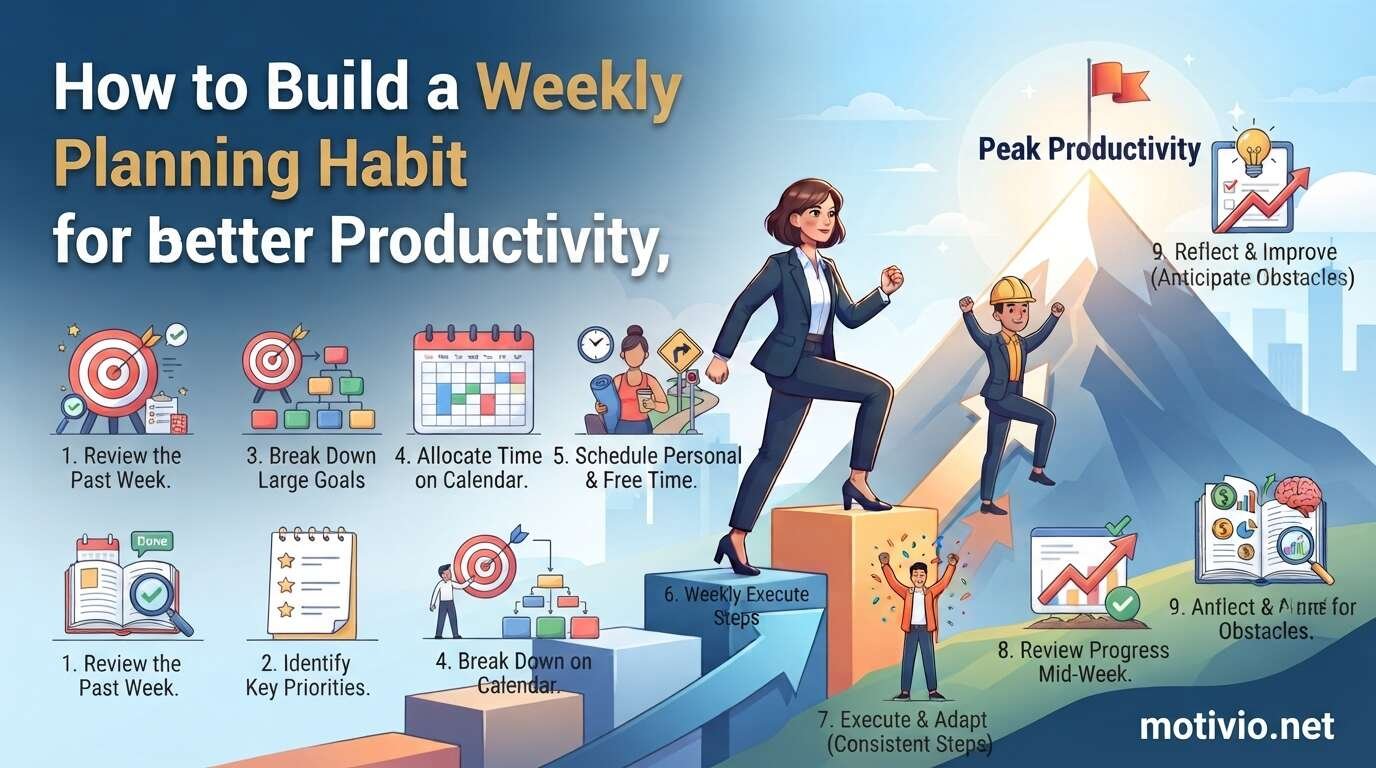
How to Build a Weekly Planning Habit for better Productivity
Have you ever finished a hectic week and questioned where all your hours went?
You might have responded to messages, participated in discussions, fulfilled chores, and dealt with surprise issues, but still feel that your key objectives were largely overlooked.
This situation is often encountered when day-to-day tasks are handled without an overarching strategy.
Establishing a weekly planning routine can assist you in arranging tasks, recognizing what is most important, and getting ready for upcoming days. Rather than making every choice at the last moment, you develop a straightforward framework that allows you to utilize your time with more purpose.
Weekly planning does not necessitate a sophisticated productivity framework. A notebook, planner, or a digital tool can suffice.
What Is a Weekly Planning Habit?
A weekly planning habit involves setting aside a specific time each week to look over upcoming tasks and decide how to arrange your schedule.
This usually means figuring out key tasks, checking due dates, deciding how much time to allocate, and considering possible challenges.
For instance, you might take 20 to 30 minutes every Sunday evening to check your work commitments, personal tasks, and objectives for the following week.
The goal isn’t to know exactly what will happen. Instead, it is to create a flexible plan that you can modify as things change.
Planning can also aid in linking your goals with actual actions. Studies in psychology have looked into how detailed plans, such as if-then strategies, can help you achieve your goals.
1. Choose a Regular Day and Time for Planning
The first thing to do is pick a consistent time for your weekly planning.
Having a fixed schedule makes it easier to remember to do it and to include it in your routine.
Some individuals prefer Sunday evenings as it allows them to get ready for Monday, while others like Friday afternoons to review what they accomplished during the week and set up for the next.
Select a time when interruptions are unlikely.
For example:
• Sunday, 6:00 p.m.
• Friday, 4:30 p.m.
• Monday, 8:00 a.m.
The particular day is less important than finding a time that fits your routine.
If a longer planning session seems daunting, start with 15 minutes. You can always lengthen it later if needed.
2. Look Back at the Previous Week
Before you plan new tasks, spend a few minutes thinking about what happened the previous week.
Consider these questions:
• What did I finish?
• Which important tasks did I not get done?
• What took up my time unexpectedly?
• What habits helped me stay on track?
• What could I change for next week?
This reflection helps you avoid automatically bringing unfinished tasks into the new week.
For instance, if you kept putting off a task because you didn’t think it would take long, you might need to allow more time for it next week.
If your week was disrupted by unexpected tasks, you might want to build in more flexibility in your new plan.
Use this reflection to gain insights from your experience instead of being hard on yourself.
3. Determine Your Key Weekly Focus Points
A successful week isn’t just about checking off as many tasks as possible.
It’s about making real progress on the responsibilities and goals that are important to you.
Start by picking two or three key focus points.
These might include:
• Focusing on a significant work project.
• Getting ready for a professional exam.
• Spending quality time with family.
• Making strides on a personal project.
• Handling an important household duty.
Write down why each focus point is significant.
This practice helps you differentiate between essential outcomes and everyday tasks that could just fill your schedule.
When everything seems urgent, it becomes tough to know what truly deserves your best effort.
4. Break Big Goals Into Smaller Steps
A weekly schedule is more effective when it includes tasks you can realistically accomplish.
For instance, saying “enhance my job” is too vague to plan.
Instead, break it down into smaller actions:
• Look up a suitable professional course.
• Finish one lesson.
• Revise your resume.
• Get in touch with a possible mentor.
• Practice answering a job interview question.
In the same way, “tidy up my home” can be changed to:
• Organize one drawer.
• Check a cupboard.
• Create a box for donations.
• Wipe down one countertop.
Smaller tasks are simpler to estimate and schedule.
They also give you a clear place to start when you are ready to begin.
5. Use a Planner to Set Aside Time
Making a list of what’s important is helpful, but it doesn’t automatically give you time to finish them.
Use a planner to assign significant tasks to certain days or time slots.
For Example
| Day | Planned priority |
| Monday | Complete the first project section |
| Tuesday | Attend a meeting and review feedback |
| Wednesday | Study for 30 minutes |
| Thursday | Finish a draft |
| Friday | Review progress and prepare next steps |
Include your current obligations like work hours, appointments, travel plans, and family duties.
Don’t try to fill every single minute of your day. Make sure to allow time for meals, breaks, transitions, and any surprises that may come up.
A schedule that allows for flexibility is usually better than one that expects every day to go as originally planned.
6. Be Careful with Time Blocking
Time blocking involves setting aside specific times for particular tasks.
For instance, you might allocate 9:00 to 10:00 a.m. for deep work and 2:00 to 2:30 p.m. for checking emails.
This strategy helps you secure time for essential activities instead of waiting for a free moment to open up.
However, keep time blocking adaptable.
If a task typically takes longer than you think, modify your time estimates. If your work has unpredictable tasks, opt for wider time ranges instead of strict hourly slots.
You can also plan regular time blocks for personal ambitions, like exercising, learning, or creative projects.
The goal is to highlight your priorities on your calendar.
7. Think About Your Energy, Not Just Your Time
Not every hour works the same for every kind of task.
Some find it simpler to do tough work in the morning, while others focus better later in the day.
Pay attention to when you feel most alert and when your energy starts to drop.
Then, when possible, arrange your tasks accordingly.
For example:
• Use your high-energy times for complex tasks.
• Set aside low-energy times for simple administrative tasks.
• Take a break after a challenging meeting.
• Don’t plan several tough activities back to back without time to recover.
Your energy levels may change due to sleep, health, workload, and personal obligations. Treat your schedule as something you can modify rather than a fixed guideline.
8. Get Ready for Interruptions and Unforeseen Tasks
Even a well-planned week can face interruptions.
A coworker might ask for assistance, a family obligation might come up, or a project may take longer than anticipated.
Instead of believing that everything will go as intended, get ready for typical interruptions.
You can:
• Keep some open time in your calendar.
• Find tasks that can be easily rearranged.
• Disable unnecessary notifications during focused work.
• Maintain a list of tasks that can be finished quickly.
• Plan how to manage urgent requests in advance.
A helpful if-then plan could be:
“If an unplanned meeting takes my study time, then I will reschedule my study session to Wednesday evening. “
This approach provides a practical solution rather than giving up on your goal.
9. Develop a Daily Review Routine
Planning your week is more effective when you check in on your schedule often.
Take a couple of minutes each morning to go over what needs to be done that day.
Consider these questions:
1. What is the top task I need to accomplish today?
2. What meetings or deadlines do I need to keep in mind?
3. Is there anything I must get ready?
4. What tasks can I push to another day if I get overwhelmed?
At the end of the day, look back at what you’ve finished and update any other tasks.
This helps link your weekly planning with what you really do each day.
10. Keep Your Planning Method Simple
Your planning system can become less effective if you find yourself spending more time organizing than actually doing tasks.
Begin with three main components:
1. A list of priorities for the week.
2. A calendar for important commitments.
3. A brief list of daily tasks.
You can utilize paper, a spreadsheet, a digital calendar, or an app for productivity.
Select tools that you are comfortable using and can easily manage.
Try to avoid regularly changing your system in search of the perfect one.
The most effective planning method is one that enables you to take action consistently.
Common Mistakes in Weekly Planning
Taking on too many tasks
Having a schedule with more tasks than you can realistically handle leads to stress. Focus on your priorities based on the time you have available.
Neglecting personal duties
Your plan should not only include work-related tasks. Family obligations, leisure time, appointments, and daily chores also require attention.
Creating an inflexible schedule
Unexpected occurrences are expected. Make sure there is flexibility in your schedule to adapt without seeing changes as failures.
Constantly reshuffling plans
Review your planning as needed, but don’t spend the entire day rearranging your tasks.
Ignoring tasks that are unfinished
At the week’s end, decide if any unfinished task should be moved to another time, simplified, assigned to someone else, or removed from your list.
Frequently Asked Questions
What is the optimal day to plan your week?
Pick a day and time that works well for you. Sunday evening, Friday afternoon, or Monday morning are good options.
How long should it take to plan weekly?
A straightforward planning session might range from 15 to 30 minutes. The right duration depends on how complex your tasks are.
Does planning weekly enhance productivity?
Planning each week can help you identify priorities, manage your time, and get ready for challenges. Its effectiveness depends on how realistically you set your plans and if you take action on them.
What is the best tool for planning weekly?
A notebook, spreadsheet, calendar, or productivity app can all be effective. Select one that you find easy to work with.
Conclusion
Making a habit of weekly planning can help you handle your tasks with more clarity and purpose.
By reviewing the past week, pinpointing priorities, scheduling key tasks, and allowing for unexpected events, you create a useful framework for managing your time.
There’s no need to plan out every single minute. Start with a brief weekly check-in and a few key priorities.
With regular practice, your planning habits can become an effective element of your personal productivity strategy.