In this article 16 sections
- Best Time Management Techniques for Busy Professionals
- 1. Start Your Day With Your Top Priorities
- 2. Use Time Blocking
- 3. Practice the Two-Minute Rule Carefully
- 4. Prioritize Tasks by Importance
- 5. Use the Pomodoro Technique
- 6. Control Email Instead of Letting Email Control You
- 7. Reduce Unnecessary Meetings
- 8. Learn to Delegate
- 9. Create a Distraction-Free Environment
- 10. Plan Tomorrow Before Finishing Today
- 11. Avoid Multitasking
- 12. Leave Buffer Time in Your Schedule
- 13. Track Where Your Time Actually Goes
- Final Thoughts
- Frequently Asked Questions
Best Time Management Techniques for Busy Professionals
Modern professionals are expected to juggle emails, meetings, deadlines, projects, personal duties, and continual digital diversions all within the same 24-hour period.
The remedy does not necessarily last longer. Effective time management entails making better judgments about where you spend your time, focus, and energy.
Whether you are an entrepreneur, manager, freelancer, employee, or business owner, using effective time management skills will help you become more productive while lowering stress.
What Is Time Management?
Time management is the process of planning and organizing how you use your available time to accomplish important goals.
Good time management involves more than creating a schedule. It includes:
– Setting priorities
– Planning tasks
– Managing distractions
– Protecting focused work time
– Delegating when appropriate
– Controlling meetings
– Reviewing your progress
– Creating realistic deadlines
The objective is not to fill every minute of your day. Instead, it is to ensure that your most valuable time is spent on your most important work.
Why Time Management Matters for Busy Professionals
Poor time management can create a cycle of constant busyness. You may spend an entire day working but still feel that nothing significant was accomplished.
Effective time management can help you:
– Complete important tasks faster
– Reduce procrastination
– Improve concentration
– Meet deadlines more consistently
– Reduce workplace stress
– Create better work-life boundaries
– Spend less time on low-value activities
– Make progress toward long-term goals
1. Start Your Day With Your Top Priorities
One of the simplest time management techniques is identifying your most important tasks before the day becomes chaotic.
At the beginning of each workday, ask yourself:
“What are the three things that would make today productive if I completed them?”
Write those tasks down.
Avoid creating a list of 20 equally important tasks. A shorter priority list makes it easier to focus.
Try the 3-Priority Rule:
Choose:
– One major task
– One important supporting task
– One smaller but meaningful task
Complete the highest-value work before spending too much time on routine activities.
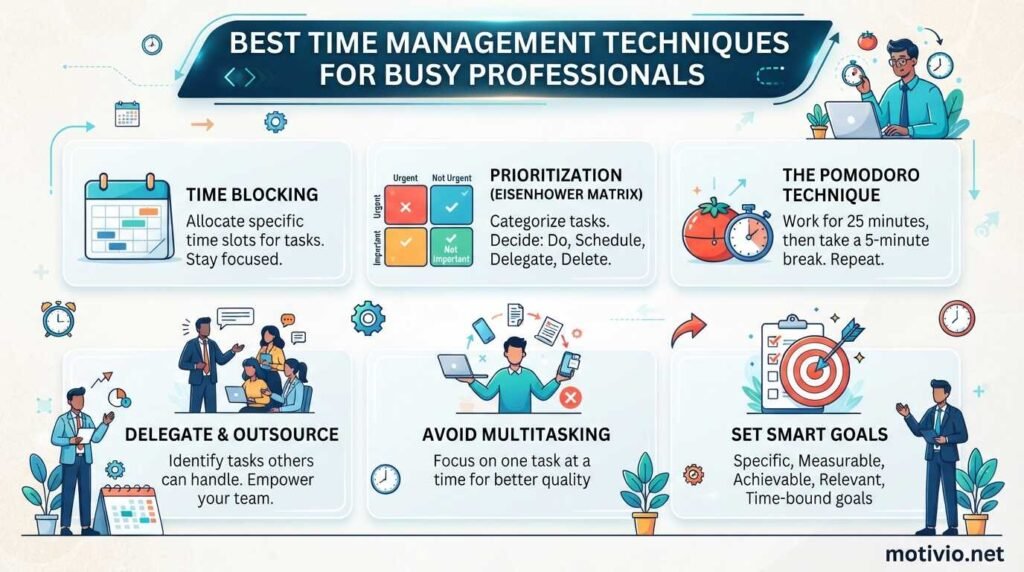
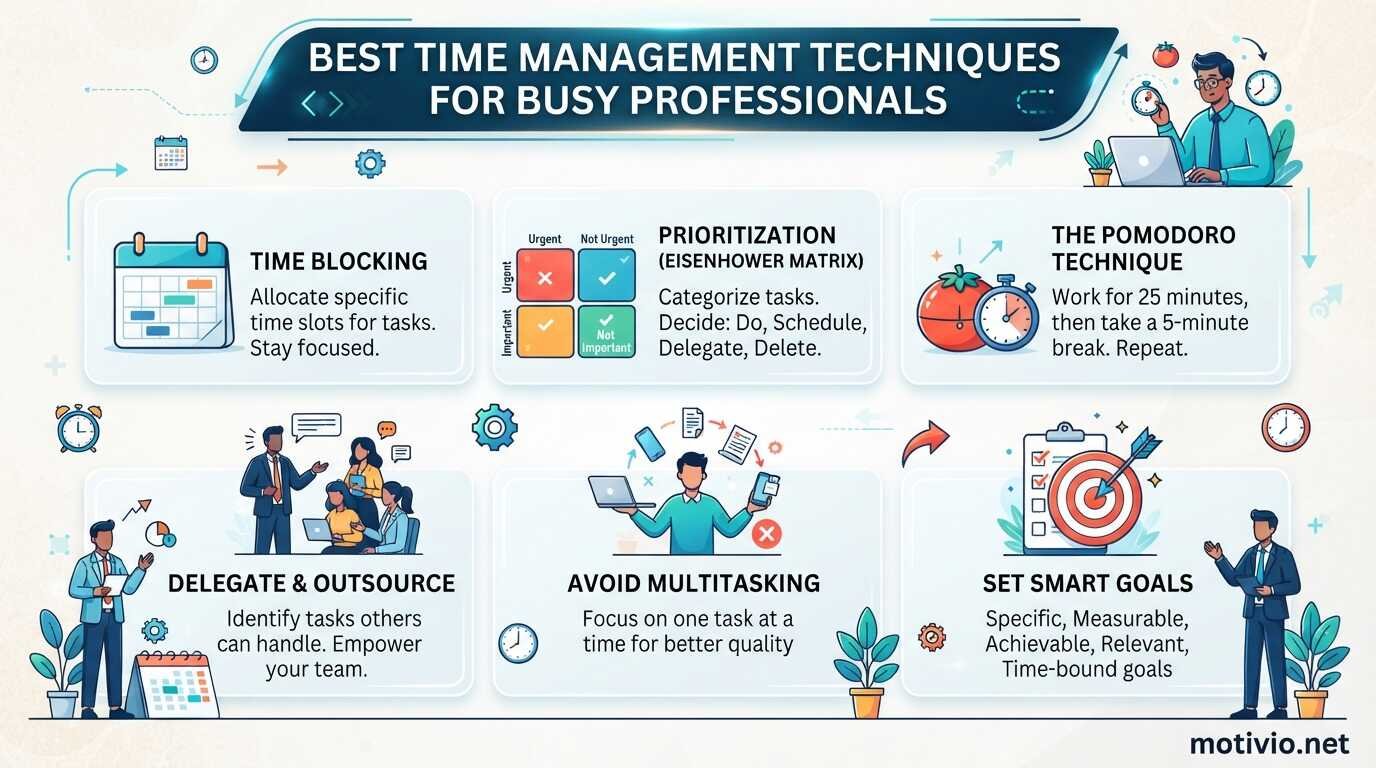
2. Use Time Blocking
Time blocking involves assigning specific periods to specific types of work.
For example:
– 8:30–10:00 — Deep work
– 10:00–10:30 — Email
– 10:30–12:00 — Project work
– 12:00–1:00 — Lunch
– 1:00–2:00 — Meetings
– 2:00–3:30 — Focused work
– 3:30–4:00 — Administrative tasks
– 4:00–4:30 — Planning and review
The advantage is that you are not constantly deciding what to do next.
3. Practice the Two-Minute Rule Carefully
If a task can genuinely be completed in about two minutes, completing it immediately can prevent small tasks from accumulating.
Examples include:
– Confirming a short appointment
– Filing a simple document
– Sending a brief confirmation
– Adding an item to your calendar
However, do not allow tiny tasks to interrupt deep work. During focused work periods, collect minor tasks and process them later.
4. Prioritize Tasks by Importance
Not every task deserves equal attention.
A useful approach is to divide tasks into four groups:
– **Important and Urgent**: Handle these quickly.
– **Important but Not Urgent**: Schedule dedicated time for them.
– **Urgent but Less Important**: Delegate or minimize them when possible.
– **Neither Important nor Urgent**: Remove them from your schedule if they provide little value.
The most productive professionals don’t simply work through their task lists; they decide which tasks deserve their attention first.
5. Use the Pomodoro Technique
The Pomodoro Technique divides work into focused sessions.
A traditional approach is:
– 25 minutes of focused work
– 5-minute break
– Repeat four times
– Take a longer break
You can also customize the method. For demanding professional work, some people prefer longer sessions, such as 45–60 minutes, followed by a short break.
The important principle is focused work followed by deliberate recovery.
6. Control Email Instead of Letting Email Control You
Checking email every few minutes can fragment your attention.
Instead, create specific email-processing periods. For example:
– Morning: 20–30 minutes
– Afternoon: 20–30 minutes
– End of day: 15–20 minutes
Turn off unnecessary notifications whenever possible.
Your inbox should be a communication tool—not your task manager.
7. Reduce Unnecessary Meetings
Meetings can consume a significant portion of a professional’s working day.
Before accepting a meeting, consider:
– Is my participation necessary?
– Is there a clear agenda?
– Could this be handled through a message?
– Does the meeting have a defined objective?
– Is there a specific decision that needs to be made?
When a meeting is necessary, establish a clear agenda and expected outcome.
8. Learn to Delegate
Delegation is not simply giving work to someone else; it is allocating tasks according to skills, responsibility, and available resources.
Consider delegating:
– Routine administrative work
– Repetitive tasks
– Data organization
– Scheduling
– Tasks that others can perform effectively
Delegation allows professionals to concentrate on work that requires their expertise.
9. Create a Distraction-Free Environment
Digital distractions can undermine productivity.
Common distractions include:
– Social media
– Unnecessary notifications
– Personal messaging
– News websites
– Constant email checking
– Excessive meetings
During focused work, consider putting your phone away, closing irrelevant browser tabs, and using website-blocking tools if necessary.
10. Plan Tomorrow Before Finishing Today
Spend the final 10–15 minutes of your workday reviewing what happened.
Ask yourself:
– What did I complete?
– What remains unfinished?
– What is tomorrow’s most important task?
– What meetings do I have?
– What can I eliminate or delegate?
Starting the next day with a clear plan can reduce decision fatigue.
11. Avoid Multitasking
Multitasking often means rapidly switching between tasks rather than doing several things simultaneously.
Every switch requires attention.
Instead of:
Email → report → phone → email → presentation
try:
Report → email batch → presentation
Working in focused blocks can make complex tasks easier to manage.
12. Leave Buffer Time in Your Schedule
A common scheduling mistake is planning every minute.
Unexpected calls, delays, technical problems, and urgent issues can arise.
Leave some unscheduled space between major commitments. A realistic schedule is more useful than a perfect schedule that collapses after one unexpected event.
13. Track Where Your Time Actually Goes
For one week, record how you spend your working hours.
You may discover that:
– Meetings consume more time than expected.
– Email takes an hour every day.
– Social media interrupts concentration.
– Administrative work takes several hours.
– Certain tasks could be delegated.
Time tracking turns assumptions into useful information.
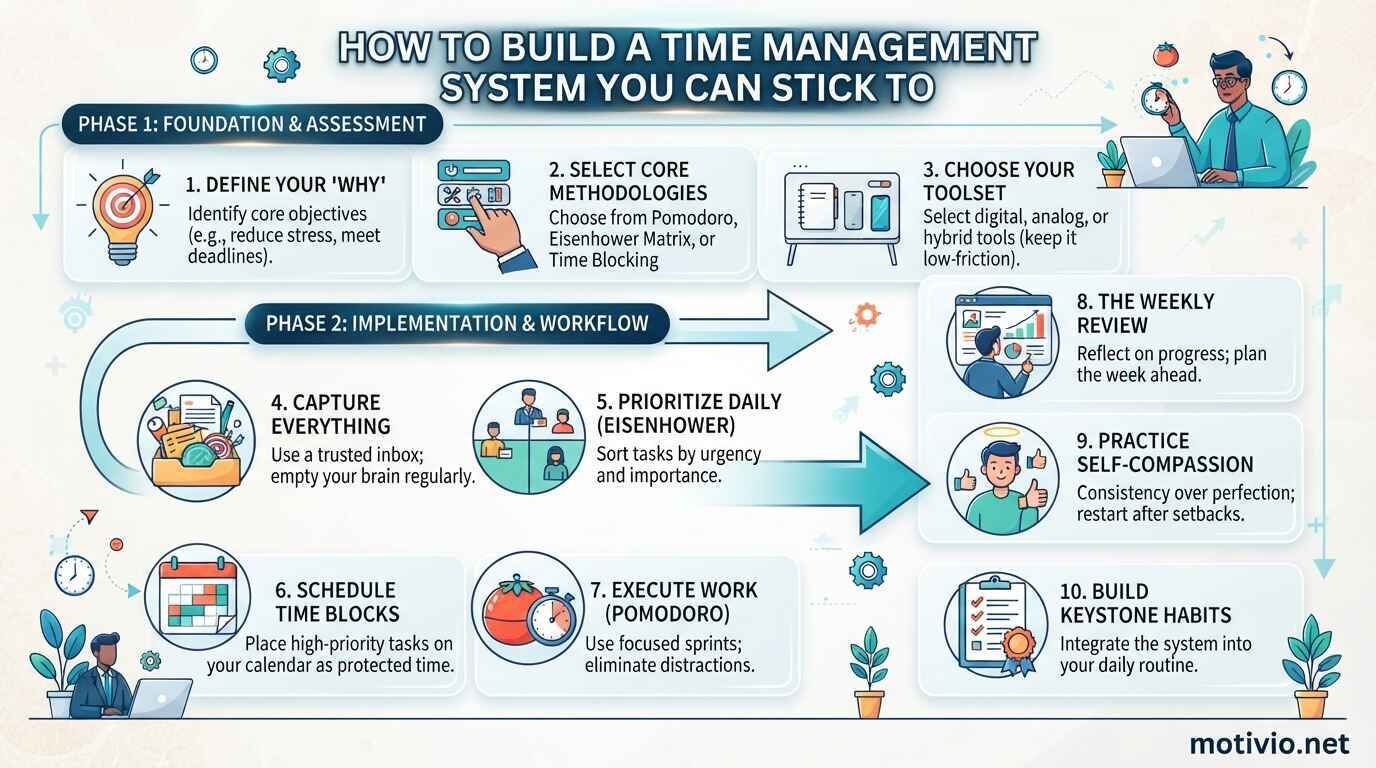
A Simple Daily Time Management System
Try this structure:
**Step 1:** Identify your three priorities.
**Step 2:** Schedule your most important task during your peak concentration period.
**Step 3:** Batch emails and messages.
**Step 4:** Group similar tasks together.
**Step 5:** Protect at least one distraction-free work block.
**Step 6:** Review your day before finishing work.
Common Time Management Mistakes
Avoid these common pitfalls:
– Creating unrealistic schedules
– Trying to complete everything yourself
– Checking email constantly
– Accepting unnecessary meetings
– Ignoring breaks
– Multitasking
– Failing to prioritize
– Spending too much time planning and not enough time executing
Final Thoughts
Effective time management is not about being busy from morning until night; it’s about using your limited time intentionally.
Start with a few techniques rather than changing everything at once. Try prioritization, time blocking, distraction control, and end-of-day planning for a few weeks. Then adjust your system according to what actually works for you.
The goal is simple: do more meaningful work while creating enough space for rest, relationships, and life outside of work.
Frequently Asked Questions
What is the best time management technique for professionals?
Time blocking, prioritization, focused work sessions, and reducing distractions are practical techniques that can work well together.
How can I manage my time when I have too much work?
Prioritize tasks according to importance and deadlines, delegate suitable work, eliminate low-value activities, and communicate realistic deadlines.
How can I stop wasting time at work?
Track your time for several days to identify major distractions and low-value activities. Then create specific rules for email, meetings, notifications, and social media.
Is multitasking good for productivity?
For complex work, frequent task switching can make concentration more difficult. Focusing on one meaningful task at a time is often a more effective approach.
How long should a productive work session be?
There is no universal duration. Experiment with 25-, 45-, 60-, or 90-minute focus periods and choose the approach that fits your work style and attention span.